
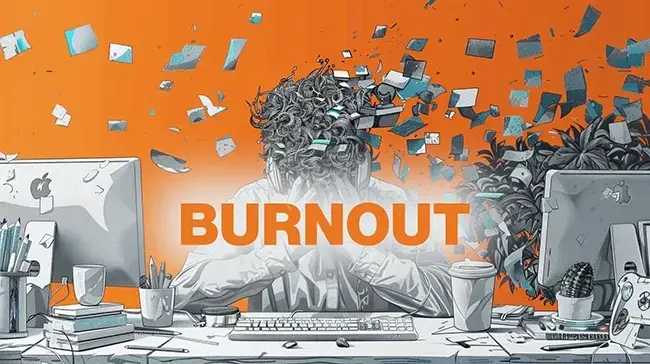


Nobody talks about this enough. The tab with 47 open terminals at 2am isn’t productivity - sometimes it’s a red flag. Let’s talk about it.
Let’s Start With the Numbers - Because They’re Brutal
Before we get into the personal stuff, let’s look at the data. Because this isn’t a “just me” problem. This is an industry-wide crisis that’s been building for years and only recently started getting acknowledged openly.
- 84% of cybersecurity professionals experience burnout -
Hack The Box, Building a Firewall Against Cybersecurity Burnout, 2024 - 76% of security professionals experienced or witnessed burnout in the past year -
Sophos, The Human Cost of Vigilance, 2025 - 63% of CISOs experienced or witnessed burnout in the past year -
Proofpoint Voice of the CISO, 2025 - 50% of cybersecurity professionals expect to experience burnout within the next 12 months -
HR Director, June 2024 - 74% have taken time off work due to work-related mental health challenges, averaging 3.4 sick days -
Hack The Box, 2024 - Job satisfaction dropped to 66% in 2024, down four percentage points year-on-year -
ISC2 Annual Workforce Study, 2024 - 47% of security professionals rank their mental health as “excellent” or “very good” - meaning more than half don’t -
Tines, State of Mental Health in Cybersecurity - 4.8 million person shortfall in the global cybersecurity workforce - meaning every existing team member carries more -
ISC2, October 2024
That last stat is the one that ties everything together. There aren’t enough people to do the work, so the people who exist in the field carry an outsized load. And that load has a weight limit.
Here’s the thing nobody tells you before you get into this field: cybersecurity is one of the few careers where failure has immediate, real-world human consequences. A developer who ships a bug delays a feature. A security professional who misses an alert might be why a hospital’s systems go down, why someone’s life savings disappear, or why a country’s infrastructure gets disrupted. That weight sits on you whether you choose to let it or not.
We need to talk about it.

Burnout isn’t weakness. The WHO classifies it as an occupational phenomenon arising from chronic workplace stress - not a personal failure.
What Burnout Actually Is — Not What We Think It Is
The World Health Organization officially classifies burnout in the International Classification of Diseases (ICD-11) as an occupational phenomenon, not a personal failing. It’s defined by three specific dimensions:
- Feelings of energy depletion or exhaustion
- Increased mental distance from your job, or feelings of negativism or cynicism about work
- Reduced professional efficacy - feeling like what you’re doing doesn’t work or matter
Notice what’s NOT on that list: laziness. Weakness. Not being cut out for it.
Burnout is what happens when chronic workplace stress is not successfully managed over an extended period. It is a physiological and psychological response to a sustained, unsustainable environment. It happens to the most dedicated, most capable people in the field - often because they’re the most dedicated.
The Cybersecurity-Specific Burnout Triggers
Our field has a unique cocktail of stressors that other industries simply don’t have in the same combination:
Always-on vigilance. Threats don’t clock out. Incidents happen at 3am on Christmas morning. The moment you switch off is the moment your adversary chooses to strike. This isn’t paranoia - it’s the reality of the threat landscape. But it creates a brain that never fully decompresses.
Alert fatigue. SOC analysts in particular face this at extreme levels. The 2023 attack on 3CX - which resulted in widespread system compromise - has been attributed in part to alert fatigue. Analysts ignored alerts they believed to be false positives. Those same analysts are the ones who live with that afterward. 75% of analysts fear missing actual incidents by dismissing false positives, according to InformationWeek. That fear is a constant companion.
Imposter syndrome at scale. The field moves so fast that even experts feel perpetually behind. New CVEs drop daily. New tools emerge weekly. New attack techniques get published constantly. The feeling that you should know more, understand more, and do more never goes away.
The weight of consequence. As one former Head of Cyber Risk for the UK’s Health Security Agency put it: “There’s always that conscious thought about ‘if it goes wrong, how could this impact the individuals on the street? How could it affect their jobs, their livelihoods?’” That’s not a thought most professions have to carry.
Understaffing by design. With a 4.8 million person global talent shortage, most security teams are running at partial capacity. You’re doing the work of 1.5 or 2 people - and the expectation is that this is just the normal state of affairs.
The Signs - Recognizing Burnout Before It Wrecks You
Most security professionals don’t recognize burnout until it’s already well advanced. We’re trained to push through discomfort. We treat rest as a productivity failure. We call running on empty “hustle.” These are cultural habits that actively prevent early detection.
Here’s what to watch for - in yourself and in your teammates:
Early Warning Signs
→ You open your CTF environment or lab and feel... nothing
→ Tasks that used to be interesting feel mechanical and pointless
→ You're irritable about things that wouldn't have bothered you before
→ You're making more small mistakes than usual
→ You're procrastinating on things you normally enjoy
→ Sleep quality is deteriorating even when you have time to sleep
→ You're thinking about work constantly, even when you're not working
Mid-Stage Signs
→ You're cynical about the work in a way that feels new
→ You're physically exhausted even after rest
→ You've started isolating from the community - avoiding Discord, forums, conferences
→ You dread Mondays with a weight that feels disproportionate
→ You've started wondering whether this career is worth it
→ Minor setbacks (a failed challenge, a rejected report) hit harder than they should
Serious Signs — Act on These
→ You're drinking more, or using substances to wind down that you didn't before
→ You've had thoughts about leaving the field entirely
→ Work is affecting personal relationships significantly
→ You're experiencing physical symptoms: headaches, chronic fatigue, stress illness
→ You're having thoughts of self-harm or hopelessness
That last category: please don’t dismiss it. The Tines study found 19% of cybersecurity professionals consume three or more drinks per day - a number that climbs to 41% among those reporting significant workplace stress. Mental Health Hackers, the nonprofit that runs villages at DEF CON and dozens of other conferences, has heard firsthand from professionals experiencing suicidal ideation linked to work stress. These are not edge cases.
🆘
If you're in crisis:You don’t have to be fine. Crisis Text Line - text HOME to741741. In the US/Canada - call or text988. In the UK - call111or999. Your life is worth more than any uptime SLA.
What Actually Helps - Practical Strategies
Let’s get specific. General advice like “take breaks” and “set boundaries” isn’t actionable enough for a community that prides itself on precision. Here’s what research and community experience actually supports.
1. Reframe Rest as a Security Control
The hacker community runs on a mythology of the caffeine-fueled all-nighter, the person who goes 72 hours deep into a problem. That mythology is actively harmful and it needs to die.
Here’s the security argument for rest: 95% of breaches involve human error (IBM). Cyberattacks are deliberately timed for afternoons when people are most fatigued. Burnout causes oversight. It causes the missed alert. It causes the misconfigured rule. A rested defender is a more effective defender, not a weaker one.
Rest is not a reward for finishing the work. Rest is part of the security posture.
Practical implementation:
→ Time-box your lab sessions: 90-minute focused blocks with hard stops
→ One day per week fully off - no terminals, no Discord security channels
→ Vacation time is not optional: treat it like a mandatory patch cycle
→ Sleep is not negotiable: sleep deprivation degrades cognitive function
   measurably after 17-19 hours awake - equivalent to a 0.05% BAC
2. Separate Identity From Work
This one is hard in cybersecurity specifically because many of us came to this field through passion, not career calculation. Hacking is a hobby that became a job. The CTFs we did for fun became the skills we get paid for. The identity merger is almost built in.
But when your work and your identity are the same thing, a bad day at work is a bad day as a person. A missed vulnerability is a failure of who you are, not what you did. That’s an unsustainable mental model.
Practical separation strategies:
→ Maintain at least one hobby that has NOTHING to do with tech
→ Have friendships outside the security community
→ When someone asks "what do you do?" practice answering with
   something other than your job title occasionally
→ Your GitHub activity graph is not a measure of your worth as a human
3. Get Honest About Your Environment
Sometimes burnout isn’t about personal coping strategies — it’s about the environment. Tines found that only 54% of workplaces prioritize mental health. If you’re in the other 46%, no amount of personal optimization fixes a structurally broken environment.
Ask yourself honestly:
→ Is my team chronically understaffed?
→ Is leadership responsive when I flag unsustainable workload?
→ Do I have any actual say in prioritization?
→ Is there a "hero complex" culture that punishes rest?
→ Has the response to every burnout conversation been
   "we'll hire more people soon" for over a year?
If the answers are consistently negative, the problem isn’t your coping skills. The Gartner forecast from 2025 that nearly half of cybersecurity leaders would change jobs was accurate — and the primary driver was work-related stress. Sometimes the move is the right call.
4. Find Your Community - The Real One
The security community has a mental health layer that doesn’t get nearly enough airtime:
Mental Health Hackers(mentalhealthhackers.org) - nonprofit running mental health villages at DEF CON, Black Hat, and dozens of other conferences. Free resources, peer support, real conversationsMind Over Cyber(mindovercyber.org) - mindfulness techniques specifically for security defendersCybermindz- Australian nonprofit that debuted in the US at RSA 2025, focused specifically on cyber professional wellbeing
These aren’t corporate wellness programs. They’re built by the community, for the community. People who have been exactly where you are.
5. The Lab Balance
For CTF players and independent researchers specifically - your lab is your passion project, not your second job. The moment it stops feeling like play and starts feeling like obligation, pay attention to that shift.
Signs your lab has become a source of stress rather than relief:
→ You feel guilty when you're not actively working on something
→ You compare your progress obsessively to others on leaderboards
→ You're grinding machines you don't enjoy because "you should"
→ You haven't done a challenge just for fun in months

Reset strategies:
→ Do one challenge this week purely because it sounds interesting -
   not because it fills a skill gap or improves your rank
→ Spend one lab session with no timer, no pressure, no agenda
→ Remember why you started - that curiosity is the whole point
The security community at its best is genuinely one of the most supportive professional communities in the world. Mental Health Hackers, Mind Over Cyber, and Cybermindz exist because people in this field show up for each other.
6. Physical Baseline -The Boring Stuff That Actually Works
Research consistently shows that these basics have measurable effects on stress resilience and cognitive performance. They’re boring. They work anyway.
→ Sleep: 7-9 hours. Not negotiable for sustained cognitive performance.
→ Movement: 20-30 minutes daily. Even walking. Especially walking.
→ Daylight: one hour of natural light per day counteracts screen fatigue
→ Social contact: in-person, outside of work contexts, regularly
→ Food: actual meals, not just whatever's near the keyboard
→ Water: chronic mild dehydration impairs cognitive function measurably
None of these are revolutionary. They’re all things most security professionals consistently deprioritize because there’s always something more urgent. There isn’t. These are the base infrastructure of a functioning brain.
The Culture Problem - And How We Start Fixing It
The deeper issue underneath individual burnout is cultural. As one security professional told CyberScoop: “A lot of us in cybersecurity are fairly high intensity and telling people that it’s okay to take a break or walk away clashes with the mythos of the caffeine-fueled hacker - that it’s the nature of the role that we’re burning the candle from both ends all the time. It’s hard to challenge norms. We are built on a burnout culture.”
That burnout culture is costing the industry people it cannot afford to lose. The Ponemon Institute found that almost two thirds of SOC professionals have thought about quitting due to stress. That’s not a talent retention problem with an HR solution. That’s a cultural problem that requires cultural change.
What that change looks like in practice:
For individual contributors: Talk about it. The normalization of these conversations has accelerated enormously in the last three years - at DEF CON, at BSides events, on Twitter/X, in private Discord servers. You don’t have to suffer in silence, and sharing your experience gives others permission to be honest about theirs.
For team leads and managers: Bitsight’s data shows organizations with good risk visibility have burnout rates of 32% vs. 63% for those without. The intervention isn’t always a wellness app - sometimes it’s giving your team the tools and visibility to feel like their work is having an impact. Control over chaos is a direct antidote to burnout.
For the community: Every time someone posts about burning out and gets a pile-on of “grind harder” - push back on that. Every time someone takes time away and comes back, celebrate that. The hero who rests is still a hero.
Key Takeaways
Burnout is structural, not personal- 84% of the field is affected; this is an industry crisis, not individual weaknessThe security-specific triggers are real- always-on vigilance, alert fatigue, imposter syndrome, and carrying the weight of consequence create a unique stress cocktailRest is a security control- a burned-out defender makes mistakes that a rested one doesn’t; 95% of breaches involve human errorSeparate identity from output- your worth as a person is not measured by your CTF rank, GitHub activity, or cert countThe community has real resources- Mental Health Hackers, Mind Over Cyber, and Cybermindz are built by and for people in this fieldIf your environment is the problem, name it- no amount of personal optimization fixes a structurally broken teamTalk about it- the most powerful intervention is normalization; if you’ve been through burnout and came back, your story matters
Have you been through burnout in this field and found something that actually helped? Share it in the comments. The person who reads it three months from now might really need it.
SEO Keywords: cybersecurity burnout 2026, hacker mental health, infosec burnout statistics, cybersecurity stress mental health, SOC analyst burnout, pentester wellbeing, mental health hackers, cybersecurity career stress, how to avoid burnout security professional, CTF player burnout
🆘 Mental Health Resources and 📞:
If you’re feeling overwhelmed, burned out, or on the edge, talk to someone now. These services are free and available.
🇰🇪 Kenya
🚨 Immediate Crisis Support
Kenya Red Cross Psychosocial Support— 1199 (24/7)Emergency Services— 999 / 112
Emotional Support & Suicide Prevention
Befrienders Kenya— +254 722 178 177 (Call / WhatsApp)Niskize— 0900 620 800 / +254 718 227 440one2one Hotline— 1190
Youth Support
Childline Kenya— 116 (Free, 24/7)
Addiction Support
NACADA Helpline— 1192 (24/7)
⚠️ Gender-Based Violence Support
GBV Hotline— 1195
Additional Mental Health Services
Mathari National Teaching & Referral Hospital— +254 713 699 715
🌍 Africa & Global Support
If Local Support Isn’t Available
Find A Helpline— https://findahelpline.com
(Find verified mental health support services by country)
🇿🇦 South Africa (Well-Structured Support)
South African Depression and Anxiety Group (SADAG)— https://www.sadag.org
(Multiple helplines for suicide, depression, and trauma)
🆘 Additional International Resources
Crisis Text Line— TextHOMEto741741US/Canada Suicide & Crisis Lifeline— Call or text988UK (NHS & Emergency)— Call111(urgent) or999(emergency)Mental Health Hackers— https://www.mentalhealthhackers.orgMind Over Cyber— https://mindovercyber.org
You don’t have to carry burnout alone. Reaching out is not weakness — it’s damage control.

Comments